Saturday, August 13, 2016

Relocating Australian tortoise sets controversial precedent

As long as it has been known to science, the diminutive western swamp tortoise has been in peril. By the time it was formally named in 1901—using a decades-old museum specimen—Pseudemydura umbrina was presumed extinct. And since it was rediscovered in the 1950s, biologists have struggled to protect it from the twin threats of habitat loss and introduced predators, which drove its numbers to bottom out at just 30 individuals in the 1980s. Now that climate change poses an even more urgent threat to the endangered tortoise, biologists have a controversial plan to safeguard its future—by moving it to new sites outside of its known historical range. The translocation, which took place today, makes the tortoise the first vertebrate to be deliberately relocated because of climate change.


The yearlong trial, several years in the planning, will track 12 captively bred juvenile tortoises released to each of two sites roughly 250 kilometers south of their native habitat on the outskirts of Perth, Australia. Although the sites aren’t ideal for the tortoises now, detailed modeling of rainfall, temperature, swamp hydrology, and tortoise biology predict they will be in half a century.

For the western swamp tortoise, whose numbers in the wild are now estimated at just 50 breeding adults, declining rainfall is the primary concern. The 15-centimeter-long tortoises feed when rains fill swampy habitats in winter, and then enter a state of dormancy known as estivation when the swamps dry out to clay pans in the late spring or early summer. The less rain in winter, the more likely the hatchlings and juveniles will starve before the next winter rains arrive. Swamps that were wet for 5 to 7 months of the year in the 1960s are now often dry for most of the year, and rainfall is set to decline further in the future. Hemmed in by urban sprawl and agricultural land, the tortoises can’t up and move, either. “It’s a double whammy,” says conservation physiologist Nicola Mitchell from the University of Western Australia in Perth, who is leading the trial.

Thursday, February 18, 2016

SCIENTISTS PROVE EXISTENCE OF A THIRD SPECIES OF TORTOISE IN MEXICO

A new study titled “The desert tortoise trichotomy: Mexico hosts a third, new sister-species of tortoise in the Gopherus morafkai-G. agassizii group” has established the existence of an otherwise unknown tortoise species in Mexico, with the name Gopherus evgoodei given to it in honor of a conservationist, naturalist, and founder of the Turtle Conservancy.

Gopherus evgoodei

For many decades, scientists had been doubtful of the variability existing among desert tortoises in Mexico, but the new study carried out by researchers from the University of Arizona has established that a third species of desert tortoise actually exists in the country, with the finding published in the journal ZooKeys.

Dr. Taylor Edwards, leader of the international team of researchers analyzed several tortoises between Sonora and northern Sinaloa over a 6-year period, eventually establishing that those from the south posses much shorter tails with flatter back shells.

Unlike its sister species, whose shells are medium to dark brown with greenish hues, while the bodies are dark gray to brownish-gray, the new tortoise is dark tan to medium-brownish with an orange cast. Again, the new tortoise species is found to live only in thornscrub and tropical broadleaf forests over 24,000 km geographic range.

Little is actually known about the behavioral inclinations of this new species but scientists continue to study it to know. The name Gopherus evgoodei was given to honor Eric V. Goode who found the Turtle Conservancy for his efforts and untiring labor to conserve the creatures.

Thursday, January 21, 2016

Cold-stunned turtles recuperate at Greensboro Science Center

In a back room at the Greensboro Science Center, twin blue tubs serve as temporary housing for four special guests — endangered green sea turtles recuperating from a sudden temperature drop off the North Carolina coast that left hundreds of the reptiles in water too cold for them to swim.
Four Green sea turtles find refuge at Greensboro Science Center after cold snap

The turtles were “cold stunned,” a condition similar to hypothermia that occurs when the water temperature changes before cold-blooded reptiles, including turtles, can migrate to warmer areas.

According to estimates, more than 600 turtles were cold stunned off the coast this month, including the four recuperating at the science center.

The turtles arrived in Greensboro last week and will stay at the center until they’re strong enough to be released into the wild, part of a statewide rehabilitation effort led by the North Carolina Aquarium.

Eight other green sea turtles are recuperating at Ripley’s Auditorium at Myrtle Beach, S.C., after they washed up on beaches along the Pamlico Sound.
Other sea turtles stunned by cold weather in New England are being treated at the South Carolina Aquarium in Charleston.

Hundreds of turtles have already been rehabilitated elsewhere and released. Determining a timeline for that process depends on the individual turtle’s case but also on the weather.

Despite there being prohibition on fishing within a distance of 20km from the beach, experts claim that trawler operators still undertake fishing illegally there.

Tuesday, December 29, 2015

Migrating turtles given help navigating Canberra nature reserve

Volunteers have been doing turtle patrols at the Mulligans Flat Woodland Sanctuary at Forde over the summer, including Christmas Day.
The eastern long-necked turtle is common in the Canberra area.
On a daily basis, they have found several creatures stopped at the sanctuary's predator-proof fence on their way in search of food, water or a mate.
"It just seems to be their natural instinct to migrate at certain times," general manager of the Woodlands and Wetlands Trust Jason Cummings said.
"But the turtles can get stuck at the fence and for whatever reason they don't turn around and go back to where they came from.
"So they will stick there and try to poke their way through but they can't get through."
The Woodlands and Wetlands Trust has also secured $1.2 million in Commonwealth, ACT Government and community funding to help it triple the size of the sanctuary.
The planned expansion would take it from 400 hectares to 1,200 hectares over the next 12 to 18 months.
"It means we can have more bettongs for example and more bush stone curlews," Mr Cummings said.
"But also we can bring other species back, species that are larger and require larger home ranges in a bigger sanctuary."
Mr Cummings said this would make Mulligans Flat the leading sanctuary for the box-gum grassy wetland ecosystem.

He said the group was still looking for donations and would need more volunteers as the fence expanded.

Friday, July 24, 2015

Veteran Takes Bullet To Protect Baby Sea Turtles

A Florida retiree went the extra mile to protect sea turtles — and got shot for it.

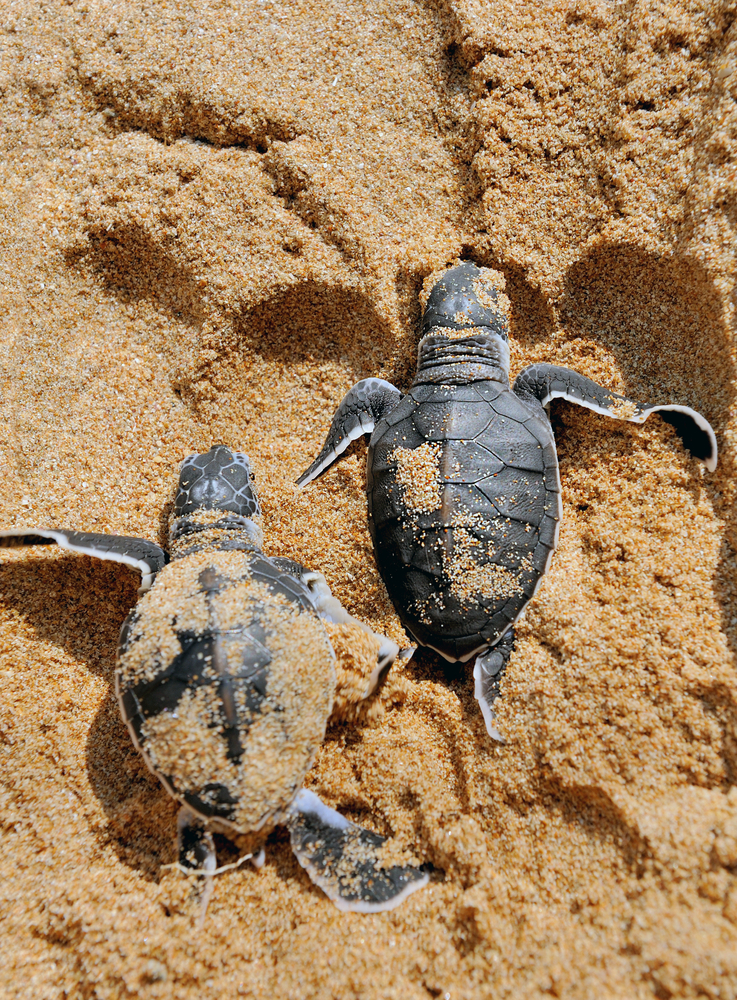
Stanley Pannaman, 72, spends his nights volunteering with a wildlife group that watches over sea turtle nests near Lauderdale-by-the-Sea, Florida. The volunteers make sure no one bothers the nesting mothers or the babies, and help the little ones get to the ocean once they hatch.

On Friday night, the night watch took an odd turn when an allegedly intoxicated man confronted the turtle watchers. "He was saying things like, 'I hate sea turtles, I hate sea turtle people, you eff eff eff people are destroying my life, I hate you,'" Pannaman told the Sun Sentinel.
The man, who has been identified as Michael Q. McAuliffe, 38, then ran to a nearby nest, screaming, and began to tear down the sticks surrounding it and to kick at the area. He threw a punch at one volunteer when they warned him he was breaking the law, the New York Daily News reported, then set his sights on Pannaman.

Pannaman, a Vietnam vet who uses a cane to walk, pulled out his gun to warn McAuliffe away, then placed it back in his pocket. But McAuliffe didn't stop. Hereportedly tackled the former Marine, pushing him into the sand and punching him in the head.

He then grabbed Pannaman's gun, which McAuliffe called a "flare gun," and tried to shoot Pannaman in the chest. The veteran pulled away just in time so the bullet hit his waist, sparing his life.


Fortunately, Pannaman survived and is recovering at home, while McAuliffe waits in jail facing multiple charges. But Pannaman says he doesn't regret anything, and will be back out protecting the turtles as soon as he can.
"Never in my wildest dreams did I think monitoring sea turtle nests was going to be a life-threatening experience," he told the Sun Sentinel.


Florida is a major nesting ground for five species of sea turtles; of those five species, one is threatened, two are endangered and two are critically endangered. Volunteers like Pannaman can make all the difference, as saving the life of even one sea turtle can be crucial to the species' survival.

Raine Island's baby turtles at risk from rising sea levels

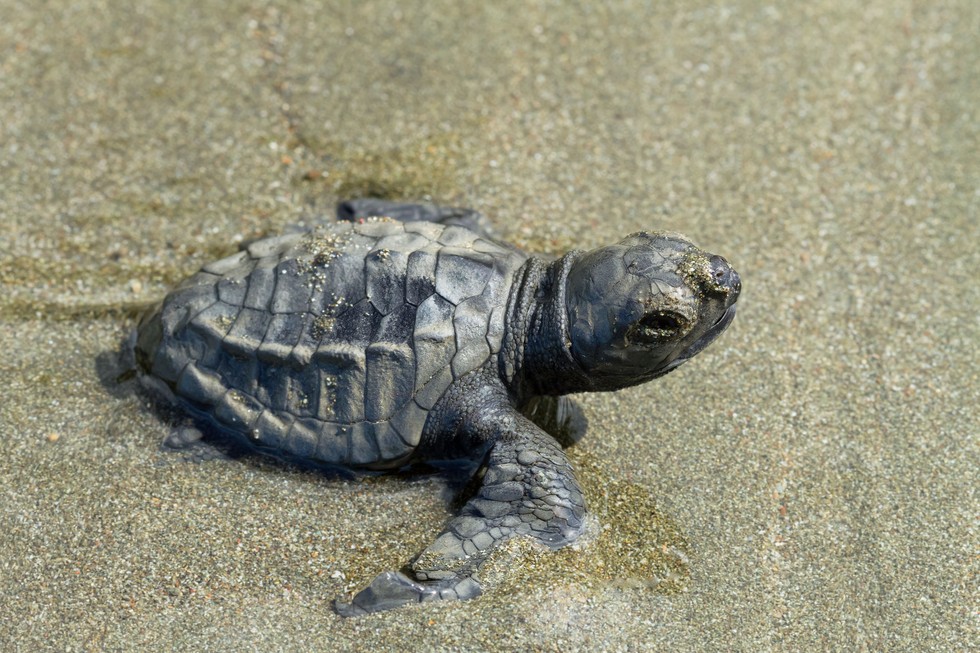
Green sea turtles might not hatch at all if sea levels continue to rise.

The research, published in the journal Royal Society Open Science, found that rising sea levels could threaten the viability of turtle eggs and lower the number of baby turtles successfully hatched.

It analysed one of the largest green turtle populations in the world, on Raine Island near the outer edge of the Great Barrier Reef.
Researchers involved set out to determine what effect rising sea levels might have on turtle eggs when they were laid. Taking eggs from Raine Island to a lab, they inundated select groups of eggs with saltwater for up to six hours at a time.

They found that eggs that were inundated with saltwater for six hours or more were up to 30 per cent less likely to hatch.
"Short periods of saltwater inundation, such as those associated with high tides during severe storms, substantially lower green turtle egg viability," the study authors wrote.

James Cook University's Dr David Pike, lead researcher of the project, said the saltwater findings could have implications for sea level rises as a result of climate change.

"We are trying to anticipate the early effects," he said. "In some places it only takes a small rise in sea levels, when combined with a storm or a king tide, to inundate what had previously been secure nesting sites."

He said human intervention may be necessary to protect green turtles in future.
"People love turtles and it is possible to mobilise large numbers of volunteers to physically move the nests further inshore. We might be able to save them with people power. The Queensland Department of Environment and Heritage Protection has also been out moving sand around the island to provide turtles with higher elevation nesting sites," he said.

Dr Kathy Townsend from The University of Queensland's Moreton Bay Research Station said the study was indicative of alarming climate changes worldwide.
"That is one of the issues that isn't just happening here in Australia but is happening around the world," Dr Townsend said. "If the sand temperatures get too hot they can basically cook the eggs, the young won't be able to survive that either."

Dr Townsend said that turtles may start migrating south, where sand temperatures are cooler.

Dr Pike said according to the current sea level trend, in as little as 50 years Raine Island and other small islands with turtle hatching ground could be inundated.


"The prediction is that within the next 50 to 100 years, with rising sea levels, the islands may be lost."